Sunday, June 16, 2013

Thursday, April 11, 2013
Sunday, March 31, 2013
Ground Ivy ~ A Weed by Any Other Name
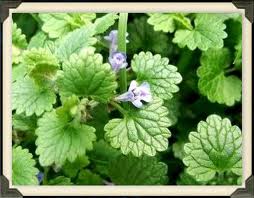
One of the first herbs I fell in love with was Ground Ivy. Yes,
it’s true. While most gardeners consider this plant a ruthless invader, the
many virtues of this mint family member will make you think twice before
plucking it.
Ground ivy is known by many
aliases: creeping Charlie, Lizzy-run-up-the-hedge, cat’s foot, alehoof,
gill-over-the-ground, creeping Jenny, haymaids…to name just a few! Eighteenth
century Swedish botanist Carolus Linnaeus cataloged this plant as glechon, Greek for “mint,” and hedera, Latin for “ivy,” but a century
later English botanist George Bentham renamed it Nepeta glechoma, or “ivy-like mint.” Several sources attribute the
name gill to a derivation of the French guiller,
meaning to ferment beer. Early Saxton invaders used the plant to flavor and
clarify beer before hops. A popular drink at the time, gill ale was believed to
impart good health to those who drank it.
Ground ivy had a strong connection with the powers of magic and
divination, as well. Considered a safeguard against sorcery, milkmaids wore ivy
when milking a newly-lactating cow to prevent spirits from enchanting the
animal. In some regions, they actually milked the cow with their arms through a
wreath of ground ivy. People also attributed ground ivy with the magical powers
to induce sleep, meditation, and healing, and promote love, friendship, and
fidelity. Ritual use of ground ivy was popular and the herb was often woven
into crowns and garlands to be worn on Midsummer’s Eve. In Scott Cunningham’s
Encyclopedia of Magical Herbs he said ~”to find out who might be using negative
magic against you, place some ground ivy around the base of a yellow candle.
Burn the candle on a Tuesday and the

person will become known to you.”
Naturalized from Europe, ground ivy now grows freely throughout the
northeast, the Midwest, and southern United States. A member of the Labiatae or
mint family, Glechoma hederacea, as
it’s now known, has the classic square stem (often covered with short, bristly,
backward-pointing hairs) of plants in the mint family. It is often
misidentified as speedwell or common mallow. A vigorous perennial with
scalloped, kidney-shaped leaves of dark green, ground ivy grows by trailing
runners, some of them as long as 39 inches. Its delicate, blue-purple,
funnel-shaped flowers bloom from March through late summer. You will find it
growing in shade or semi-shade, in wooded areas and ditches, or along
roadsides.
Throughout the centuries, ground ivy was highly regarded for it
medicinal value. Gerard recommended using it “against the humming noise and
ringing sound in the ears…and for them that are hard of hearing.” People used
the plant more effective ways, ingesting the juice for its diuretic properties
and applying it topically as an astringent. It is considered especially useful
for sinus congestion and headaches, and taken as a hot infusion for head colds.
The expressed juice, used fresh and “snuffed” up the nose prompted relief from
colds and migraine headaches, as did a snuff made from the dried powdered
leaves. Gill tea acted as an expectorant and was a popular remedy for
consumption, whooping cough, bronchial catarrh, and asthma. Now known to have a
high vitamin C content, ground ivy was useful in the prevention and treatment
of scurvy.
The ability of ground ivy to act as both a stimulant and tonic made
“gill tea” especially useful for those suffering from digestive complaints.
Acting as a blood purifier, it proved helpful for those suffering from kidney
ailments such as gravel or stones.

As a lotion or compress, ground ivy was used to cleanse sores and
ulcers. When combined with yarrow and chamomile flowers, it made a poultice for
abscesses, boils, and skin tumors. Culpepper declared it “a singular herb for
all in ward wounds, ulcerated lungs, or other parts, either by itself, or
boiled with like herbs…and being drank, in a short time, it easeth all griping
pains, windy, and choleric humours in the stomach, spleen, or belly.”
The juice of ground ivy came highly recommended as a treatment to
relieve “black eyes.” Galen physician to five Roman emperors, combined ground
ivy’s flowers with celandine and daisies, claiming that “stamped, strained, and
a little sugar and water put thereto and dropt into the eyes, takes away all
manner of inflammation…yea, although the sight were well-nigh gone.”
Gill tea was the tonic of choice for cleansing the blood and
tissues of any toxic metals, including lead poisoning, or painter’s colic as it
was known. According to Greek physician Dioscorides, “half a dram of the leaves
being drunk in four ounces and a half of fair water for 40-50 days together is
a remedy against sciatica or ache in the huckle-bone.”
Today, scientists are studying ground ivy as a potential treatment
for bronchitis, hepatitis, HIV, leukemia, and other cancers. Herbalists still
recommend it as a poultice for bruises and sore spots, and you’ll find it in
products that support lung function (some studies show it helps relax bronchial
muscles), and those that combat cough, flue, and yeast infections. High in iron
and vitamin C, it also makes a healthy addition to the diet.
In the garden, ground ivy forms an attractive ground cover that
also helps to keep the soil from eroding. While tall plants and bulbs usually
remain unscathed by the addition of this plant, shorter plants and ground
covers are no match for the spreading mint family member, so choose your
growing spot wisely, and make sure to incorporate a barrier around it. The
lovely blue flowers are attractive to bees, butterflies, and on occasion even a
hummingbird. Ground ivy also grows in less fertile areas and stays green nearly
all year long. Pluck overgrown ivy and add it to the compost pile.
Feeling adventurous? Try adding a few leaves of ground ivy to
salads or sprinkle it on some soup. To make a gill spring tonic, infuse one
ounce of ground ivy with one pint of boiling water and sweeten with honey or
sugar. When cooled, strain and drink small amounts several times a day. Try it
over ice on warm days.
While your local nursery might not offer this plant anytime soon,
ground ivy boasts a range of uses that secure it a place above the common weed.
If you do remove some of it, at least take the time to reflect on its long
history ~ it is a small herb with a tremendous determination!
Katherine Turcotte
Herb Quarterly Magazine Spring 2008
Tuesday, March 27, 2012


Monday, January 9, 2012
Thursday, November 24, 2011
Tuesday, October 11, 2011
Wednesday, August 3, 2011
Ten Helpful Herbs for Fibromyalgia
Click on the link below to read my article from the Llewellyn 2011 Herbal Almanac. Please note that my name on this blog is my pen name. Enjoy. Please remember that this article is copyright protected. Do not copy this article for your website without my express permission. Thank you!


Tuesday, July 19, 2011
Aromatherapy & Essential Oil Quality

Aromatherapy uses essential oils to benefit human beings physically, mentally, and emotionally. The essential oils enter the body through inhalation via the nose or olfactory system. They may also be ingested through a suitable carrier such as oil, where they penetrate the skin and eventually enter the circulatory system. Pure essential oils are the “life force” of the plant, and they cannot be duplicated in a lab with additives. These oils are obtained from plants’ roots, leaves, bark, stems, rhizomes, flowers, fruit rind or seed. These essential oils are the exclusive product from extraction of volatile aromatic principles or distilled oils. For this reason, it is important that a pure essential oil not be used directly on the skin. A single essential oil can contain well over 100 or more chemical constituents.
Adulteration of essential oils can occur at any stage in the supply chain. The distillation process is an important factor in the gathering of these oils. The use of pure water with no additives used in the distillation process, low temperature, low pressure and a long distillation time are needed to preserve the pure essence of the plant and to capture the quality of the essential oils.
A technique called GLC, or Gas Liquid Chromatography, is used to give a highly detailed analysis of the oil. This type of testing is the most common and will show any added adulterant. Other tests on essential oils are infrared, optical, rotation, specific gravity and mass spectrometry.
Adulteration of an essential oil can be as simple as adding a component to stretch or standardize the essential oil. It can be a simple or complex process. Examples of adulterations are added alcohol, the addition of lemon or orange terpenes, and synthetic additives such as DPG or PEA to “bulk” up or augment an oil. A common process of adulteration involves taking a cheap oil such as lavindin and selling it as lavender.
When looking for a pure essential oil, it is important to do your homework. Many oils are sold as fragranced or perfumed oils and are considered adulterated. They have been cut with other oils or synthetic chemical components. This is why it is important not to purchase an oil based on scent alone. Perfumed oils are often mixed with chemical pesticides or other additives that dilute the oil so it can be produced at a cheaper price. The water used in distilling these “perfumed” oils may contain chlorine and other harmful chemicals.
Good quality essential oils will not feel greasy to the touch. These oils will be bottled in amber brown bottles so they will be shielded from light. Make sure the oils you purchase are certified organic. Pure essential oils will have a product specification sheet which describes how the oil was obtained and distilled and that tells you the country or region from which it came. It will have a batch number, production date and chemical data that lists the seven major components of essential oil. Traceable protocols will state that it contains no added water, alcohol, carriers or diluents.
Use common sense when dealing with essential oils. Although many essential oils are GRAS, or, generally regarded as safe by the FDA for internal use, check with a qualified aromatherapist or herbalist first. Since pure essential oils are volatile, do not use them near heat or flames. Some oils will cause sun sensitivity, especially those in the citrus family. Always dilute an essential oil before applying it to skin to avoid irritation. Store your oils out of direct light and heat and be sure to replace the cap tightly to avoid evaporation. Citrus oils can be refrigerated. If you mix your oils with a carrier oil, the shelf life of the oil will depend on the type of carrier oil used. For safety reasons, follow any precautions listed on the oil, as many are not considered safe during pregnancy. Above all, remember that aromatherapy is only as good as the quality of essential oils used.
Thursday, July 14, 2011
Wednesday, July 13, 2011
Prayer to the Goddess of the Moon
Wondrous Lady of the Moon
You who greets the dusk with silvered kisses;
Mistress of the night and of all magicks,
who rides the clouds in blackened skies
and spills light upon the cold Earth;
O Lunar Goddess,
Crescented-One,
Shadow maker and shadow breaker;
Revealer of mysteries past and present;
Puller of seas and ruler of women;
All-wise Lunar Mother,
I greet your celestial jewel
at the waxing of its powers
With a rite in Your honor.
I pray by the Moon,
I pray by the Moon,
I pray by the Moon.
You who greets the dusk with silvered kisses;
Mistress of the night and of all magicks,
who rides the clouds in blackened skies
and spills light upon the cold Earth;
O Lunar Goddess,
Crescented-One,
Shadow maker and shadow breaker;
Revealer of mysteries past and present;
Puller of seas and ruler of women;
All-wise Lunar Mother,
I greet your celestial jewel
at the waxing of its powers
With a rite in Your honor.
I pray by the Moon,
I pray by the Moon,
I pray by the Moon.
Thursday, July 7, 2011

Wednesday, July 6, 2011
Saturday, July 2, 2011
The Many Uses of Lavender

 Lavender, the fragrant woody perennial herb, has over twenty-eight species and an even greater multitude of varieties. It dates back as far as the first century and to ancient Rome and Greece. It was even used among the ancient Egyptians in the mummification process. It has enjoyed its popularity over time for a variety of uses that still continue today. Lavender essential oil is the most popular in the United States, outselling all the other essential oils. If you have never had the intense pleasure of inhaling pure lavender essential oil, you are in for quite a treat!
 Traditional uses for lavender included expelling worms from children, and use against lice and insect bites. Lavender was also a popular strewing herb for disinfection. More common uses are for stress relief, insomnia, depression and indigestion. It is used in several pharmaceutical products including antiseptics, cosmetics and anti-inflammatory products. Lavender was used extensively during the 19th century in the making of perfume. It is interesting to note that during World War I and II, that lavender was used when medical supplies were scarce to prevent infection and to relieve pain.
Over the centuries, lavender has been associated with powers in love, chastity, longevity, protection, purification and happiness. Inhaling the scent of lavender is known to increase the alpha brain waves in the back of the head, aiding in relaxation and tranquility. Thus, our immune system is boosted by the benefit of lavender.
Growing lavender requires full sun, space between plants and good drainage. Lavender does not like "wet feet", so excellent drainage is essential. It is best harvested just before flowering, when the oil concentration is highest. With all the varieties available, it will not be hard to find one suited to your growing area. Flower colors range from white, to pink, blue and purple. Professionally, lavender is distilled for use in essential oils by steam.
When purchasing lavender, become familiar with each variety's botanical name. The most widely grown is the hardy Lavandula Angustifolia, also known as L. vera, L. officinalis, or English Lavender. They can range in height from a mere 8" to over three feet tall. Other popular varieties known for their sweet fragrance are 'Munstead' and 'Hidcote' lavender.
Other uses of lavender include dabbing it on your temples when you have a headache and using it on pillows to combat insomnia. It is a common ingredient in sachets and potpourri and is used to scent linens and prevent moth and bug activity. It is also used in flower arranging and crafts, i.e., lavender wands.
Lavender is one of the few essential oils that can be applied "neat" to the body without the addition of a carrier oil. It is useful on burns, insect bites and minor skin irritations. Mixing fifteen drops of pure lavender essential oil with common bath salts such as sea or Epsom salts will provide a bath that is pure heaven!
Lavender also has culinary uses. It is used to flavor jellies, honeys, cookies and breads. A wonderfully relaxing tea or tisane can be made using boiling water, honey and lavender flowers.
Katherine Turcotte 's article appeared originally online in Body,Mind,Spirit Magazine Online.
Wednesday, June 29, 2011
Monday, June 27, 2011
Another Days Blessing
Every day there is magic around me. Today my deer, Brown Town Brownie came to visit. I love that she is not afraid of me and does not flinch when I stand just feet from her. She is one of Gloria’s from last year I believe and she was always one to stay close to home.
She looks at me with such trust in her eyes, and I know that as I talk to her, she is really listening to me. She is one of the deer that will come when called, usually bounding through the forest to get to where I am. In the fall when all the leaves are down and carpeting the forest the sound of the deer coming to eat still sounds to me like people moving towards me.

Gloria, the piebald and Missy came to eat later this afternoon. Gloria had the two little fawns with her; how magical they are with their miniature little bodies and tiny spots. They follow their mother to the corn and then decide it is much more fun to run and play some reindeer games. I laugh as I watch them scamper about the woods playing hide-and-seek; mother deer always on alert for them.
Brownie was slightly limping tonight perhaps she stepped on something or misjudged a step. Most days though, she stays close to home content to lie in the cool dirt of the valley. As summer moves on, the babies will grow quickly. I am always pleased when there is a late season birth so that I will have a little one or two to entertain me through till winter. I can’t imagine my life without the companionship of the deer….

Blessed be,
Priestess Absinthe Aradia
Wednesday, June 22, 2011
Litha Blessings
Some days I tend to take life for granted. We all get caught up in the same grind of routine, day after day. But some days, the Goddess just comes up and smacks us right in the head when we least expect it. Today was one of those days.
Going through the motions of morning chores, dogs out, dogs in, cats fed, it was time to walk up the hill and see if the deer were there to eat and also to shut the porch light off on the cabin. Usually I will find my one brown deer, Brownie, hunkered down in the cool dirt of the valley but this morning she was not there.
On the way back down the path, off to my right something light colored near the long ago fallen logs caught my eye….it was a tiny baby fawn, cream colored with a brown patch on the top of her head (a patch that also had a white mark inside of it). She did not startle when I stopped, completely in awe that this magnificent little being was so close to me and yet seemed so comfortable. I stopped and just gazed at her, cooing softly that it was okay, I was not going to hurt her.
Earlier in the season, I had asked my ‘girls’ as I call Gloria, Missy and the gang, to bring me a baby this year, one I could get very close to. I promised them that I would not hurt it, and that I would be honored to know that they trusted me enough to bring a young one so close. Today, that wish was granted.

I walked back to the house, grabbed the camera and headed back up to snap some pictures. A little off to the right of the deer, I saw movement in the leaves and a box turtle was making its way across the leaves less than a foot from the baby deer. The tiny deer let me snap her picture about six times, stardom did not seem to bother her. I put the camera down and edged a little closer to her with a handful of deer corn; she stood up and looked at me, still showing no fear. Okay, I said to myself, I have been given this really wonderful gift today and I watched as she stretched and leaped a few feet away from me to the other side of the forest.
As I loaded the pictures in my computer I realized how very lucky I am to be able to have such creatures of beauty so close to me every day. How many people can say when they walk in the woods they can call out a few names and have deer suddenly come from all areas of the forest to eat just feet from me? Or that one winter they actually got to pet the long lithe neck of a blind white doe in the middle of a blizzard, a doe that seemed to magically dance around my legs…a doe that had supposedly been shot and killed days earlier by police for fear of her carrying a disease. I can assure you, that deer is not dead, or if she was then I was visited by a White Spirit Deer in the true sense of the word.
Suddenly my mundane day did not seem so mundane any more, it had turned magical. The Goddess is all around me, every day She has gifts for me, some tiny like a butterfly flitting around me in the garden, some not so tiny like two majestic white bucks. But this I can tell you, magic is real and it is around me every single day, and this little doe is living proof!
Blessed be,
Priestess Absinthe Aradia
Wednesday, June 15, 2011
Subscribe to:
Posts (Atom)